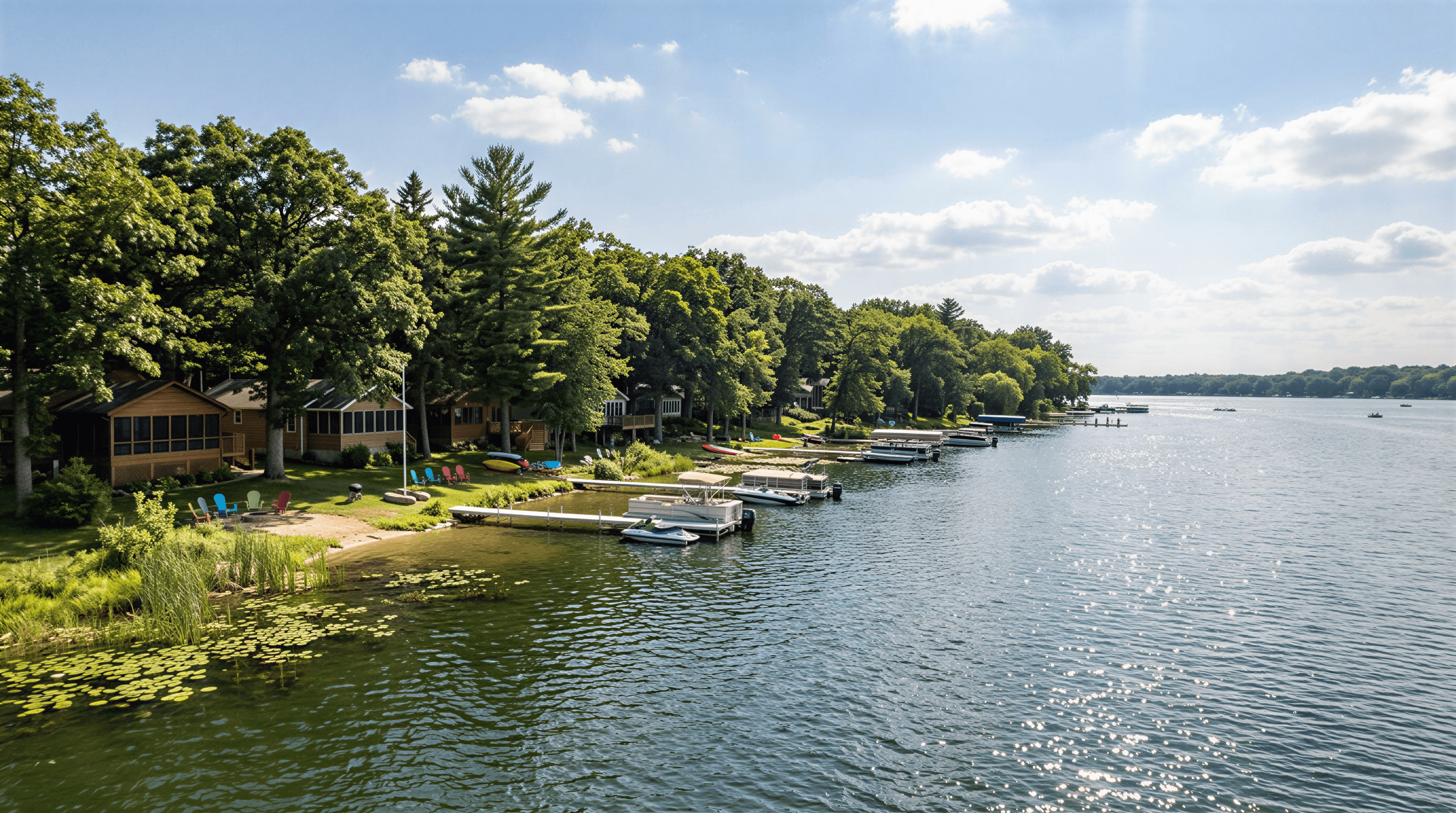

Frontage is the thing everyone talks about on Geneva Lake. Acreage is the thing that is actually running out.
There are roughly 21 miles of shoreline here, and almost all of it was carved up generations ago. The original Gilded Age estates ran to dozens of acres each. Most were subdivided decades ago into the lots that make up today's lakefront market. The handful that survived intact are the rarest real estate in the Midwest, and they trade so infrequently that a buyer can wait years for one.
This guide covers the five private luxury estates with acreage that define the Geneva Lakes, what each one teaches you about the segment, and the practical part nobody publishes: what estate acreage actually costs here in 2026 and how to buy it without inheriting somebody else's zoning problem.
One note up front. Several of these properties are private residences, and this article names none of their current owners. If you walk the Shore Path past them, stay on the path.
The short answer
The five estates that define acreage ownership in the Geneva Lakes are Black Point, Stone Manor, House in the Woods, the former Loramoor estate, and the Snake Road corridor on the north shore. Black Point is a public historic site. Stone Manor is now condominiums. House in the Woods remains a private estate. Loramoor was subdivided. Snake Road is where the remaining acreage parcels still change hands.
Together they tell one story: land here gets divided, almost never reassembled.
1. Black Point, Town of Linn
Built 1888. National Register of Historic Places. Now a public historic site.
Black Point is the best-documented estate on the lake because you can actually go inside it. Chicago beer baron Conrad Seipp completed the 20-room Queen Anne home in 1888, and the original property sat on nearly 27 acres with close to half a mile of undisturbed Geneva Lake shoreline.
That is the number to sit with. Twenty-seven acres and half a mile of frontage, held by one family.
Today the Wisconsin Historical Society operates the site across seven acres with 620 feet of shoreline, and it was added to the National Register in 1994. Visitors arrive by boat from the Riviera docks, the same way the family's guests did.
What it teaches a buyer: the gap between 27 acres and 7 acres is the entire history of this market. Almost every large estate on the lake went through some version of that division.
2. Stone Manor, City of Lake Geneva
Built 1901. Largest estate ever constructed on Geneva Lake. Now six condominiums.
Stone Manor is the most searched building on the lake and the most misunderstood. Retail and real estate millionaire Otto Young began it in 1899 and finished in 1901. Legendary's own profile of the property puts it at seven levels including two sub-basements, roughly eight acres of lakefront land, and over 400 feet of water frontage. It was placed on the National Register of Historic Places in 1979.
Young enjoyed it for about five years before his death in 1906. After that the property became, in order, a girls' school run by the Episcopal Church, a county tax foreclosure, a French restaurant, a Christmas tree museum, and finally luxury condominiums.
What it teaches a buyer: subdivision is not always horizontal. When an estate becomes too large for any single household to carry, conversion is the exit. Anyone buying into a converted historic property is buying an association and a preservation obligation, not just square footage.
3. House in the Woods, north shore
Built 1906. Still a private estate with dozens of acres.
House in the Woods was built for hardware magnate A.C. Bartlett and designed by Howard Van Doren Shaw, the architect who shaped more of this shoreline than any other. At The Lake Magazine notes the U-shaped home is defined by large arched bay windows and triple archways that Shaw carried into his later Geneva Lake commissions, with a terrace and courtyard at the rear.
The grounds matter as much as the house. The Olmsted Brothers, the firm founded by the sons of the designer of Central Park, created planting plans for north shore estates including House in the Woods, Wychwood, and Wadsworth Hall.
It remains privately owned and is not open to the public.
What it teaches a buyer: properties like this essentially do not come to market. When one does, it is usually a generational transition rather than a listing, and it is often resolved before it is ever public.
4. Loramoor, and what became of it
The cautionary tale, and the reason today's estate lots exist.
Loramoor was one of the largest holdings on the lake, and it no longer exists as a single property. In the late 1910s, Lewis E. Myers purchased a portion of the former Loramoor estate and in 1924 built Allegheny, another Howard Van Doren Shaw design, on the piece he acquired.
That pattern repeated around the entire lake through the twentieth century. Estates were cut into pieces to meet demand for more lakefront homes, more lake access homes, and eventually condominiums.
What it teaches a buyer: most parcels currently marketed as "estate lots" on Geneva Lake are fragments of something much larger. Pull the plat history. It tells you where the easements, shared drives, and odd boundary lines came from, and those are the things that surface at closing.
5. The Snake Road corridor, north shore
Not one estate. The place where acreage still trades.
Snake Road runs the north shore between Lake Geneva and Williams Bay, and it is the highest concentration of surviving estate property on the lake. It is also the practical answer for a buyer who wants acreage rather than a museum tour.
Parcels here range from a few acres to genuinely large holdings, some with frontage and some set back across the road with lake views and no shoreline. That second category is where value hides. You give up frontage and gain land, privacy, and a materially different price per acre.
What it teaches a buyer: on this lake, "estate with acreage" and "lakefront" are two different purchases. Decide which one you are actually making before you start touring.
Why so few of these ever come to market
The supply math is brutal, and it is worth understanding before you set expectations.
According to Legendary's 2026 Geneva Lake waterfront market analysis, lakefront inventory sits roughly 22 percent below 2020 levels, the lakefront segment appreciated about 45 percent cumulatively from 2020 through 2025, and the Town of Linn south shore carries the highest median waterfront price on the lake at around $4.2 million. Linn is specifically described as having very limited turnover, which is what happens when families hold property across generations.
Meanwhile the land itself keeps getting more expensive statewide. USDA National Agricultural Statistics Service data put Wisconsin farm real estate value at an average of $6,420 per acre in 2025, up $300 from the prior year. An analysis of actual recorded sales from the University of Wisconsin, reported at $7,238 per acre for 2025, showed a 9.6 percent increase over 2024 and a 70.5 percent rise since 2020.
Here is the figure that matters most for estate buyers. In 2024, Wisconsin agricultural land that stayed in agricultural use sold for an average of $8,937 per acre, while land being diverted to other uses averaged $19,083 per acre, according to Department of Revenue transfer return data compiled by NASS.
That gap is the conversion premium. It is what you pay for land whose use is changing, and near a lake like this one, it is the floor rather than the ceiling.
What estate acreage costs in the Geneva Lakes in 2026
The market splits into three fairly clean tiers.
Lakefront estate with real acreage. Frontage plus meaningful land, usually on the south shore or along Snake Road. Expect well into eight figures on the rare occasion one trades.
Near-lake estate acreage. A larger parcel with lake views but no frontage, often just across the road. Low seven figures and up, depending on acres and improvements.
Inland estate acreage. Ten to a hundred or more acres in the surrounding townships, or near Lake Como, Delavan Lake, or Lake Beulah. Priced off land value plus improvements rather than off frontage.
For context on the surrounding market, the Wisconsin REALTORS Association reported a February 2026 statewide median price of $315,000, with 3.1 months of available inventory and an average 30-year fixed mortgage rate of 6.05 percent. Estate property in this area operates in a completely separate universe from that median, but the rate environment still shapes what buyers are willing to finance.
How to buy an estate with acreage in the Geneva Lakes
Estate acreage has failure modes that a normal home purchase does not. Work this list in order.
- Pull the plat and chain of title before anything else. Most large parcels here are remnants of subdivided estates. You are looking for shared driveways, utility easements, lake access easements benefiting neighbors, and boundary lines that follow something other than the survey. Order a current survey. Do not rely on the seller's old one.
- Check the assessment classification. If any portion is enrolled in Wisconsin's agricultural use value assessment, converting it to residential or recreational use can trigger a conversion charge. Ask the county assessor what the parcel is classified as now and what changing it would cost.
- Ask about conservation easements or a Managed Forest Law enrollment. Both restrict what you can build and both run with the land. An MFL enrollment in particular carries withdrawal penalties. This does not make a property bad, it makes it a different property than the listing implies.
- Verify well and septic capacity for what you intend to build. Estate parcels are frequently outside municipal service. Get the well log, get the septic system inspected and sized against your planned bedroom count, and find out whether a replacement system would even perc on the site you want to build on.
- Confirm shoreland zoning if any part touches water. Walworth County shoreland and floodplain rules govern setbacks, impervious surface, tree removal, and shoreline structures. These are the rules that decide whether the boathouse or the pool you are picturing is legal.
- Check for historic designation. A National Register listing does not by itself prevent you from renovating a privately owned home, but local landmark ordinances and preservation easements can. Find out which, if either, applies before you budget a renovation.
- Price the annual carrying cost honestly. Property taxes on a large parcel, grounds maintenance, private road maintenance agreements, insurance on outbuildings, and lakefront structure upkeep if applicable. Estates are not expensive to buy so much as expensive to keep.
If you are early in this process, the highest-value hour you can spend is a conversation about which tier you actually belong in. Schedule a consultation with the Legendary team before you start touring, because the wrong tier wastes an entire season.
Frequently asked questions
What is the largest estate on Geneva Lake?
Stone Manor in the City of Lake Geneva is the largest estate ever built on the lake. Completed in 1901 for Otto Young, it has seven levels including two sub-basements and sits on roughly eight acres with over 400 feet of water frontage. It was divided into six luxury condominiums and is not open to the public.
Can you tour any of the historic Lake Geneva estates?
Black Point Estate and Gardens is open to the public as a Wisconsin Historical Society site, typically from May through October, with visitors arriving by boat through the Lake Geneva Cruise Line. Most other landmark estates on the lake are private residences and are not open for tours. The Geneva Lake Shore Path passes many of them, but the path is the only public access.
How many acres did the original Geneva Lake estates have?
The originals were large. Black Point sat on nearly 27 acres with close to half a mile of shoreline when it was completed in 1888. Loramoor was larger still before it was broken up. Most were subdivided across the twentieth century into the smaller lakefront lots that make up today's market, which is why intact acreage is now so scarce.
Is it cheaper to buy acreage near Lake Geneva instead of on it?
Substantially. Parcels set back from the water, or near Lake Como, Delavan Lake, or Lake Beulah, price off land and improvements rather than off frontage. Wisconsin agricultural land diverted to other uses averaged $19,083 per acre in 2024 according to state transfer return data, compared with $8,937 for land staying in agricultural use.
What should I check before buying a large parcel in Walworth County?
Start with the plat, chain of title, and a current survey to find easements and shared drives. Then confirm the assessment classification, any agricultural use value enrollment or Managed Forest Law enrollment, well and septic capacity, county shoreland and floodplain zoning if the parcel touches water, and whether any historic or conservation designation restricts construction.
The bottom line
The top private luxury estates with acreage in the Geneva Lakes are not a shopping list. Black Point belongs to the public. Stone Manor became condominiums. House in the Woods stays in private hands. Loramoor was divided generations ago. Snake Road is the only one of the five where a buyer can realistically transact.
What they collectively prove is that land here moves in one direction. It gets divided, and it does not get reassembled. Anyone who wants meaningful acreage in the Geneva Lakes is competing for a supply that shrinks every decade.
That is not a reason to rush. It is a reason to be ready and to know exactly what you are looking for before it surfaces. Browse current Geneva Lake listings or call 262-204-5534 and we will tell you honestly what is realistic at your number and what is not.

About Jade Goodhue
Expert real estate agent specializing in Lake Geneva and surrounding areas. Helping families find their dream homes with personalized service and local market expertise.
Contact Jade Goodhue