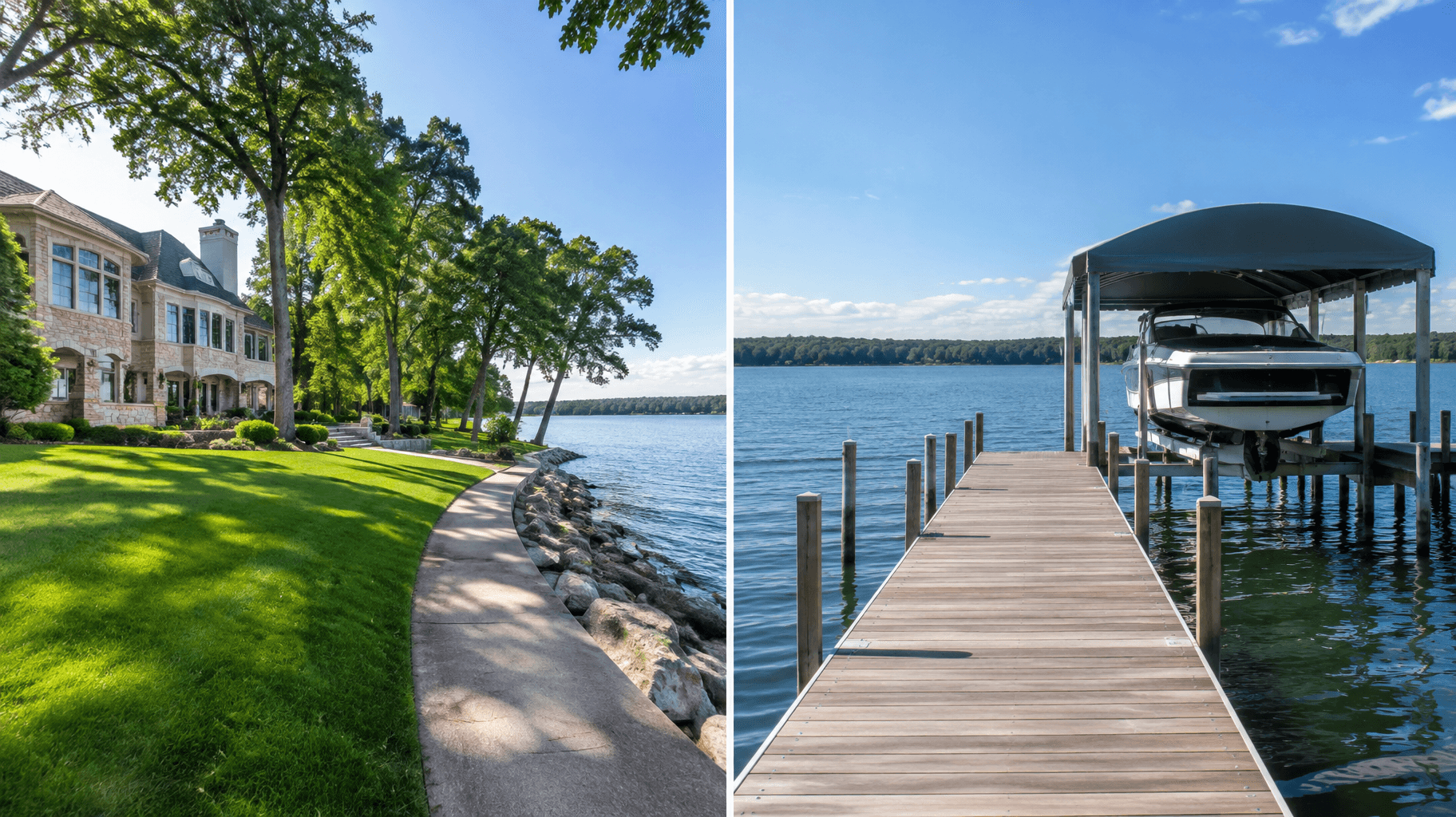

The renewal notice arrives in February. Same house, same lake, same claim-free record, and the number is up again. For many Geneva Lake owners that letter is the first real conversation they have about lake home insurance in Wisconsin, and it happens after the rate is set.
Most lakefront owners who end up underinsured did not cheap out. Their policy was built around the wrong number, the flood exclusion was never explained, and nobody added up what the pier, boathouse and lift would cost to rebuild.
By the end of this guide you will know what Wisconsin lakefront owners actually pay, why premiums keep climbing, how flood coverage works, where second home policies cost more, and a step-by-step process for getting a quote that holds up after a storm.
What lake home insurance costs in Wisconsin right now
Wisconsin is still one of the cheaper states for home insurance. Using 2022 NAIC data, Farmers reports a Wisconsin average of $957 per year against a $1,569 national average. More recent analysis from ValuePenguin puts the Wisconsin average near $1,394 a year for $350,000 of dwelling coverage, about a third below the national number.
Those averages are close to useless for a lakefront home. They assume $300,000 to $350,000 of dwelling coverage, and a Geneva Lake home is often insured for four to eight times that. Premium tracks the cost to rebuild the structure, not the sale price and not the state average, so what lake home insurance costs in Wisconsin scales with your replacement cost, your roof, your fire protection class, and whether the house sits empty five days a week.
No credible source publishes a Wisconsin lakefront-specific average, so anyone quoting you one is guessing. What you can control is the inputs.
Why Wisconsin lakefront premiums keep climbing
Premiums rose 55% in seven years. According to Wisconsin Public Radio's reporting on a study co-written by UW-Madison associate professor Philip Mulder, Wisconsin home insurance premiums rose an average of 55 percent between 2017 and 2024. Nationally the figure was 63 percent. The drivers were climate-related disasters and construction costs.
Storms, not hurricanes, are now the expensive peril. The Insurance Information Institute found that tornadoes, hail, straight-line winds and severe thunderstorms caused $51 billion in U.S. insured losses in 2025, the third straight year above $50 billion and more than any other disaster category. Hail alone can account for up to 80 percent of those claims.
The Midwest is carrying more of the load. Moody's analysis of early 2026 found that with quieter activity in Texas and Colorado, Wisconsin, Illinois, Ohio and Michigan contributed proportionally far more to insured losses than in recent years, with straight-line wind a major factor.
Rebuild costs outran policy limits. The dwelling limit written in 2019 does not rebuild the same house in 2026. Carriers raise limits, premium follows, and it reads as a rate hike even when your risk did not change. Underwriting tightened alongside it: older roofs, older wiring and long vacancies all draw more scrutiny than they did five years ago.
The second home problem
A large share of Geneva Lake homes are weekend and summer places owned by families from Chicago and Milwaukee. That changes the policy three ways.
It is not automatic. Wisconsin's Office of the Commissioner of Insurance is explicit that a summer home is not automatically covered by the policy on your primary residence. Some carriers handle it with a Secondary Residence Premises Endorsement, others write a separate policy.
It costs more. The Insurance Information Institute notes that a vacation home carries more risk than a primary residence because an unoccupied house is more exposed to theft, vandalism and undetected damage like a burst pipe. ValuePenguin reports State Farm applying roughly a 10 percent secondary home surcharge and Nationwide around 20 percent, and Insurify puts the national secondary home average at $2,693 a year.
It may not qualify as a homeowners policy at all. OCI notes that dwelling policies, which carry more limited property coverage and no liability coverage, are commonly used for seasonal homes unoccupied part of the year. If you winterize and walk away for five months, ask your agent which form you are on.
The Wisconsin wrinkle is freeze. A lake house with the heat set low and nobody checking it can lose a supply line in January and thaw into a six-figure water loss. Many policies carry a maintained-heat or drain-the-lines condition, and if you did not meet it, the claim is contestable.
Flood insurance for a Wisconsin lake home
This is the biggest coverage misunderstanding on the water.
Your homeowners policy does not cover flood. OCI lists flood, surface water and overflow of a body of water, including wind-driven spray, as standard exclusions. FEMA says the same nationally, noting that most homeowners insurance does not cover flood damage and that flood is a separate policy.
NFIP has hard caps. Residential coverage tops out at $250,000 on the building and $100,000 on contents. On a lake home with a $1.5 million rebuild cost, that leaves $1.25 million exposed, which is why higher-value waterfront owners layer private excess flood on top.
There is a 30-day waiting period. FEMA notes a policy typically takes 30 days to take effect, with narrow exceptions for loans and map changes. You cannot buy it when the forecast turns. Spring melt planning happens in January.
What Wisconsin owners pay. The state carries roughly 12,700 active NFIP policies at an average annual premium near $911, per OpenFEMA policy data as of March 2026. Your number turns on elevation and foundation type, not the zone letter.
Whether you have a choice. The Wisconsin REALTORS® Association explains that flood insurance is mandatory when a structure sits in a special flood hazard area, the A or V zones on the Flood Insurance Rate Map, and the buyer uses a federally backed loan. Locally, Walworth County's Shoreland Zoning Code reaches all unincorporated land within 1,000 feet of a lake, pond or flowage, or to the landward edge of the 100-year flood elevation.
Sewer backup is a third thing entirely. OCI notes that a sewer or sump pump backing up is excluded from homeowners, probably not covered by flood either, and requires an endorsement most companies will not offer unless you ask. On a lakefront home with a finished lower level, that is not optional.
Three ways to insure a lakefront home, with the trade-offs
Standard HO-3 with endorsements. Covers the dwelling and detached structures against any peril except those specifically excluded, with sewer backup, scheduled valuables and watercraft coverage bolted on. Pros: widely available, competitively priced, replacement cost settlement on the dwelling. Cons: other structures and personal property limits are formula-driven and usually far too low on the water.
A high-value program. Built for homes above roughly $1 million in replacement cost. Pros: guaranteed or extended replacement cost, broader other structures limits, better handling of custom finishes and detached lake structures. Cons: higher premium and stricter roof and electrical underwriting.
The Wisconsin Insurance Plan. The state's insurer of last resort. Pros: it exists when nothing else will write you. Cons: per OCI, WIP settles losses at actual cash value rather than replacement cost, and cannot renew you after four years.
Six things that move the number on a Geneva Lake home
- Replacement cost, not market value. OCI warns directly against confusing the two. On Geneva Lake, land is often most of the price, so insuring to the sale price is a costly mistake in both directions.
- Roof age and material. With hail driving most storm claims, roof age is the first thing underwriting checks. An 18-year-old asphalt roof can trigger a declination or an actual cash value roof schedule.
- Fire protection class. Wisconsin communities are graded 1 to 10 on water pressure, department access and firefighter training. OCI notes rural areas carry higher classes and higher prices, so a home down a private lane prices differently than one inside city limits.
- Wood-burning fireplaces and legacy wiring. Historic lake cottages come with knob-and-tube, undersized panels and unlined chimneys.
- Claims history and credit. OCI notes that repeated wind and hail claims, even ones outside your control, can push an insurer to require a higher deductible. Wisconsin also permits credit-based insurance scores as one underwriting factor.
- Short-term rental use. The sleeper on Geneva Lake. OCI warns that once you earn rental income, an insurer could treat you as running a business and deny coverage. Tell your agent before the listing goes live, not after a guest gets hurt on the pier.
Two coverage gaps, in dollars
The other structures gap. OCI notes that coverage for other structures is usually 10 percent of the coverage on your house. On a home insured at $1.5 million, that is $150,000, stretched across the boathouse, pier, boat lift, detached garage and shoreline stairs. One permitted Geneva Lake boathouse can consume that limit by itself. Consider an owner who loses a pier and a boathouse roof in an August wind event and finds the combined rebuild is $260,000 against a $150,000 limit. The $110,000 difference is a check they write.
Landscaping is worse. Trees, plants and shrubs are typically covered at 5 percent of the dwelling amount, capped near $500 per item, and OCI notes the coverage excludes windstorm entirely. A wooded lot that loses eight mature oaks in a derecho is a landscaping bill, not a claim.
The replacement cost trap. OCI is specific that full replacement cost coverage generally requires insuring the building at 80 to 90 percent of replacement cost, and guaranteed replacement cost typically requires 100 percent. Consider a couple who bought a Geneva Lake home for $1.6 million and insured the dwelling at $1,050,000 because their agent worked off the assessment. If the real rebuild cost is $1.5 million, they are at 70 percent, and the replacement cost language on their declarations page does not work the way they think. That changes how partial losses settle, not just total ones.
Insurance is one of three big annual line items on a lake property. Read it alongside our breakdown of Lake Geneva property taxes and homeownership costs.
How to shop lake home insurance in Wisconsin: a seven-step process
- Get a real replacement cost estimate. Not assessed value, not purchase price. Ask a local builder for a per-square-foot rebuild number for your construction type, or have your agent run a replacement cost estimator and show you the output.
- Inventory the other structures separately. Walk the property and write down the pier, lift, boathouse, seawall, stairs, shed and detached garage with a rebuild estimate for each. That total is the limit you need, not 10 percent of something else.
- Pull the flood determination and price it. Confirm the zone on FEMA's Flood Map Service Center. In an A or AE zone with a federally backed loan, coverage is mandatory. Quote both NFIP and private flood, and start a month ahead of spring melt to clear the 30-day wait.
- Gather the underwriting documents. Roof age and material, electrical panel type and amperage, plumbing material, heating system age, distance to the nearest hydrant and fire station, alarm and shutoff systems, and any claims in the last five years.
- Get three quotes on identical specs. OCI is blunt that the comparison only means something if every agent gets the same information: same dwelling limit, same deductible, same endorsements. Use at least one independent agent who can shop multiple carriers.
- Ask the six questions that matter. Is dwelling settlement replacement cost, extended, or guaranteed? Is the roof on replacement cost or an age schedule? Is the wind and hail deductible flat or a percentage? Is sewer and sump backup included, and at what limit? Does the other structures limit cover the pier and lift? Is short-term rental use permitted?
- Add an umbrella, then rerun this every two years. OCI notes umbrella policies commonly come in $1 million and $5 million limits above your home and auto liability. Rebuild costs and carrier appetite both move, and a policy priced right in 2024 can be underinsured and overpriced at once in 2026.
If your carrier drops you
Per OCI, a Wisconsin insurer must deliver a nonrenewal notice at least 60 days before expiration, state the reason, and explain how to apply to the Wisconsin Insurance Plan. Use that window to shop. Storm damage on the record is a common trigger, which is why handling the first 24 hours after wind, rain or hail damage correctly matters well beyond a single claim.
Frequently asked questions
How much is lake home insurance in Wisconsin?
Wisconsin's statewide average runs between roughly $957 and $1,394 a year depending on the source, but those figures assume $300,000 to $350,000 of dwelling coverage. Lakefront premiums scale with replacement cost, roof age, fire protection class and occupancy, so a high-value lake home with separate flood coverage lands well above them.
Does homeowners insurance cover flood damage on a Wisconsin lake home?
No. Wisconsin's Office of the Commissioner of Insurance lists flood, surface water and overflow of a body of water as standard exclusions, including wind-driven spray. Flood requires a separate policy through the National Flood Insurance Program or a private carrier. Sewer and sump pump backup is excluded from both and needs its own endorsement.
Is flood insurance required for a Wisconsin lakefront home?
Only in certain cases. If the structure sits in a special flood hazard area, the A or V zones on the Flood Insurance Rate Map, and the buyer uses a federally backed mortgage, purchase is mandatory. Outside those zones it is optional but often still sensible, since elevation and drainage matter more than the zone letter.
Why does a second home cost more to insure than a primary residence?
Because vacancy is a risk. The Insurance Information Institute notes that a home you do not occupy full time is more exposed to theft, vandalism and undetected damage such as burst pipes. Carriers price that through surcharges commonly in the 10 to 20 percent range, and some seasonal homes qualify only for a more limited dwelling policy.
Does my policy cover my pier, boathouse and boat lift?
Partially, and usually not enough. Detached structures share an other structures limit set around 10 percent of the dwelling coverage, covering the pier, boathouse, lift, detached garage and shoreline stairs together. On higher-value lakefront properties one structure can exhaust that limit, so it should be raised deliberately.
The bottom line
Lake home insurance in Wisconsin is not expensive by national standards. It is just easy to get wrong on the water, where market value and rebuild cost diverge, the flood exclusion is absolute, and a formula-driven other structures limit has no idea what a Geneva Lake boathouse costs. Premiums are climbing for reasons that will not reverse, so the leverage is in accuracy: the right replacement cost, the right limits on the right structures, and flood coverage bought early.
If you are buying, selling, or reassessing what a Geneva Lake property costs to hold, we can pressure-test the numbers with you. Get in touch with the Legendary team, or start with our Lake Geneva waterfront market overview.

About Jade Goodhue
Expert real estate agent specializing in Lake Geneva and surrounding areas. Helping families find their dream homes with personalized service and local market expertise.
Contact Jade Goodhue